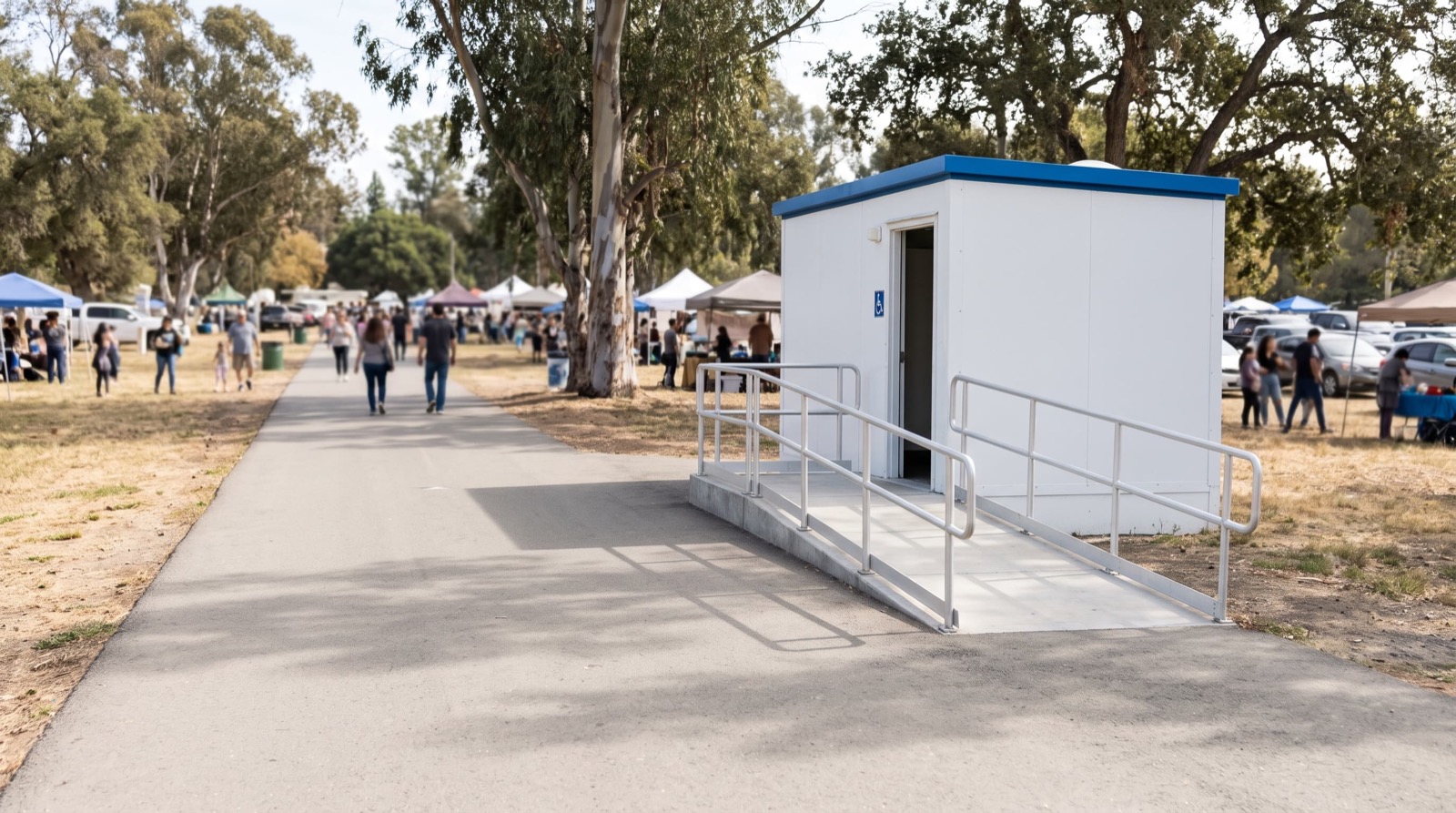
Think of it as a route, not a unit
An accessible portable restroom is only part of the picture. Someone arriving at your event needs a way to get from parking to the unit, a surface they can roll or walk on and room to maneuver at the door. Plan the whole path and the unit will actually work.
Decide early who sets your requirements
Whether you must provide accessible facilities, and how many, depends on the type of event, whether it is public, the venue and local rules. Your city permit office, venue manager or an accessibility professional can tell you what applies. We cannot give legal advice, but we can price the quantity you decide on. California also has its own accessibility rules in addition to federal law, so it is worth checking with the authority that covers your location.
The surface under the route
- Best: pavement, concrete or a firmly compacted surface.
- Risky: loose gravel, deep mulch, sand, tall grass and ruts from vehicles.
- Seasonal: winter rain can soften an orchard or vineyard lane that was perfectly firm in summer. Dry weather can also kick up dust. Choose a route that works in both conditions.
Placement checklist
- As close as practical to accessible parking and the main gathering area.
- On level ground, not on a slope or cross-slope.
- With clear space in front of the door to turn a mobility device.
- Along a route that is wide enough, free of cables, hoses and steps.
- Lit, if your event runs after dark.
- Marked with clear signs from the main paths.
Add handwashing the same way
If you provide handwashing, make sure at least one station is positioned and designed for use from a mobility device, and place it beside the accessible unit. See handwashing stations to ask about options.
Different events, different priorities
- Street fairs and festivals: place accessible units in more than one cluster so nobody has a long walk. See festival rentals.
- Weddings: think about older family members and the walk from the ceremony to the units. Our wedding guide has more.
- Sports and runs: put accessible units near the start and finish, not only at the edges of the course.
- Work sites: if a worker or visitor needs an accessible option, mention it when you call for a quote.
Heat and distance
In Central Valley and desert summers, a long walk on hot ground is hard on anyone, and harder for people with limited mobility. Shade along the route and a short path make a real difference. See the heat, rain and wildfire guide.
Surfaces in detail: mats, sand and dirt
Many California venues have ground that is firm in one season and soft in another: beach sand, orchard and vineyard lanes, fairground dirt, decomposed granite paths and grass fields. If your route crosses any of them, ask the venue what is allowed. Temporary mats or portable walkways can turn sand or soft ground into a usable path, but they need to be laid out before the event and checked for gaps and lifted edges. A short, firm route usually beats a long, matted one. On dirt, think about dust in dry months and mud after rain, and pick a route that works in both.
Slopes, thresholds and door clearance
- Slope. Choose level ground for the unit and the approach. A ramp that is too steep, or a cross-slope that tilts a chair sideways, can make an otherwise suitable unit unusable.
- Threshold. Check how the unit meets the ground. Gaps, lips and uneven pads can catch small wheels.
- Door swing and turning room. Keep the area in front of the door clear of cords, barricades, signs and parked carts so a mobility device can approach and turn.
Parking, signage and lighting
Place accessible units as close as is practical to accessible parking and the main gathering area, and mark the route with clear signs from the points where people arrive. If the event runs after dark, light the path and the door, since uneven ground is harder to see at night. A short, shaded, well-marked route helps everyone, and in California inland summers it can be the difference between a usable setup and one people avoid.
Handwashing height
If you provide handwashing, position at least one station beside the accessible unit and ask about a model that can be used from a seated position. Keep the approach clear and the ground firm around it so the setup works as a whole.
How the plan differs by event type
- Festivals and fairs. Long distances and crowds make clusters important. Put accessible units in more than one location, away from the busiest chokepoints.
- Weddings. Think about older relatives and the walk between ceremony, dining and the units. Lawn, gravel and vineyard rows often need a firm path laid down.
- Job sites. Site conditions change daily. If a worker or visitor needs an accessible option, mention it on the call so the placement and the approach can be planned.
Common mistakes to avoid
- Placing the unit on a slope or at the end of a long gravel path.
- Forgetting to include the unit's quantity in the first call, then finding it unavailable on the date.
- Skipping a conversation with the venue about mats or approved routes.
- Putting handwashing too far from the accessible unit.
Questions to take to your permit office or venue
California has its own accessibility rules in addition to the federal ADA, and requirements for temporary events vary by city, county and venue. We cannot give legal advice, so please verify with your local permit office, your venue manager or an accessibility professional. Useful questions include how many accessible units are expected for your attendance, what route and surface standards apply, whether temporary mats are permitted and whether any signage or lighting is required.
What to tell us when you call
Surface type at the site, distance between parking and your unit location, how many guests you expect, and whether you want accessible units alone or alongside standard ones. We will confirm what is available for your date. Our accessible rentals page explains what to expect.
Questions about your event? Call for a quote and we will help you plan.
Last updated October 14, 2026. This guide is general information, not legal, engineering or regulatory advice.